
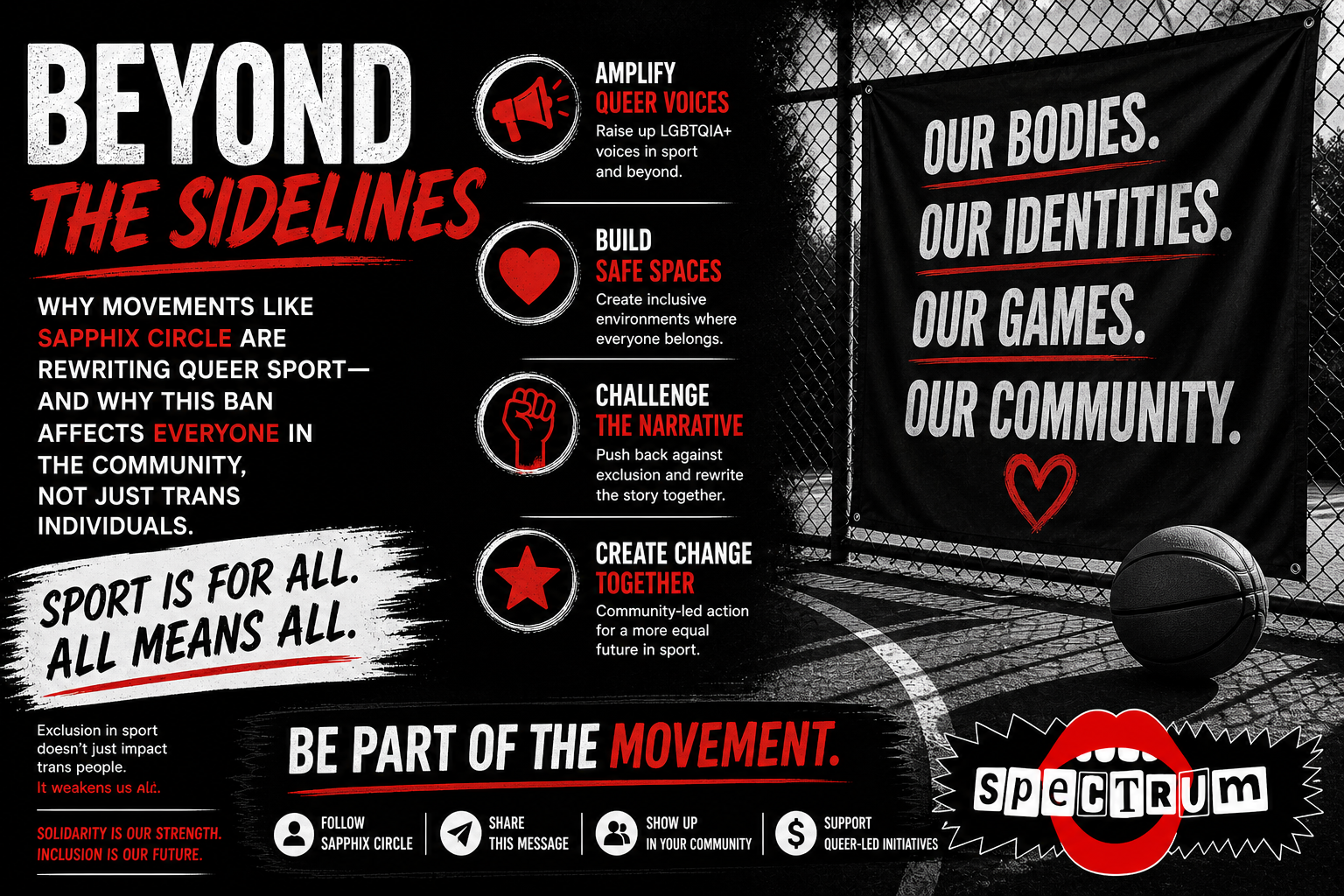
For years, the conversation around LGBTQIA+ inclusion in sport has been framed as a question of visibility. Who gets to play. Who gets to compete. Who gets to be seen. But visibility, as emerging movements are increasingly making clear, has never been enough.
Across the UK and beyond, a new wave of grassroots, community-led initiatives—like Sapphix Circle—are beginning to challenge not just policies, but the narrative itself. They are reframing sport as a cultural space, not just a competitive one. And in doing so, they are exposing something deeper: that restrictions targeting trans athletes don’t exist in isolation—they ripple across the entire LGBTQIA+ community.
A New Generation, A New Narrative
Sapphix Circle represents something distinct from traditional advocacy groups. It’s part of a new generation of queer-led spaces that aren’t waiting for institutional permission to exist. Instead, they are building their own ecosystems—spaces where identity, sport, creativity, and community intersect.
What makes movements like this powerful is not just their message, but their timing. They are new, up-and-coming, emerging in a moment where sport is undergoing intense scrutiny over who belongs and who doesn’t. Rather than reacting defensively, they are proactively redefining inclusion on their own terms.
This mirrors a broader shift happening across queer culture. As outlined in your mission, “visibility isn’t enough” . The focus is moving away from simply being seen, toward creating meaningful, sustainable impact—where representation is paired with opportunity, safety, and real-world change.
Sport Has Never Been Neutral
Sport is often presented as a level playing field—objective, merit-based, and fair. But for LGBTQIA+ individuals, it has historically been anything but.
From locker room cultures to institutional policies, sport has long been a site of exclusion. Trans athletes are currently at the centre of that conversation, but they are not the first to be scrutinised, and they won’t be the last.
What movements like Sapphix Circle highlight is that these debates are rarely just about performance or fairness. They are about belonging. Who is considered “normal.” Who is allowed to take up space. And who is asked to justify their existence.
Why Trans Exclusion Affects the Entire Community
It’s easy—particularly in mainstream media—to frame restrictions on trans women in sport as a niche issue. But that framing misses the broader impact.
When a group is excluded based on identity, it reinforces a hierarchy within the LGBTQIA+ community itself. It sends a message that inclusion is conditional—that some identities are more acceptable than others.
This has several consequences:
- Increased policing of gender expression: When eligibility is tied to rigid definitions of sex or gender, it doesn’t just affect trans individuals. Cisgender queer women, non-binary people, and gender non-conforming athletes often find themselves scrutinised as well.
- Fragmentation of community spaces: Sport has always been a key site for building connection. Exclusionary policies fracture those spaces, making it harder to maintain solidarity across identities.
- A chilling effect on participation: When people see others being excluded, they are less likely to participate themselves. This impacts mental health, wellbeing, and access to community—issues already identified as systemic challenges within LGBTQIA+ life .
In short, when one part of the community is pushed out, the entire ecosystem weakens.
From Policy to Culture: Where Change Really Happens
What sets movements like Sapphix Circle apart is that they understand something institutions often miss: policy is only one part of the equation. Culture is where real change happens.
Rather than focusing solely on governing bodies or elite competition, these groups are building grassroots alternatives:
- Community-led sporting events
- Safe spaces for queer participation
- Platforms that celebrate identity rather than regulate it
This aligns closely with the kind of “grassroots meets guerrilla” approach described in your mission, where change begins in communities, not boardrooms .
By creating spaces that are inclusive by design—not by exception—they challenge the idea that traditional sport structures are the only option.
Rewriting What Queer Presence in Sport Looks Like
There is also a cultural shift happening in how LGBTQIA+ people are perceived within sport.
Historically, queer athletes have often been forced into narrow narratives: the “exceptional” individual who overcomes adversity, or the “controversial” figure who disrupts norms. Both frames place the burden on the individual.
Movements like Sapphix Circle reject that framing entirely. Instead, they present queer participation in sport as:
- Collective rather than individual
- Celebratory rather than defensive
- Integrated into culture, not separate from it
This reflects a broader ambition to “change the narrative” through authentic representation and conversation—not debate .
Why This Moment Matters
We are at a turning point. The past few years have seen increasing restrictions in certain areas of sport, particularly at elite levels. At the same time, there has been an explosion of queer creativity, community-building, and grassroots activism.
These two trends are not separate—they are in direct conversation with each other.
Sapphix Circle and similar movements exist because of this tension. They are both a response to exclusion and a vision for something better.
They are saying:
- Sport can be inclusive without losing integrity
- Community can exist outside institutional approval
- And queer people don’t need to shrink themselves to fit into existing systems—they can build new ones
More Than a Moment—A Movement
What makes this especially significant is that these initiatives are still in their early stages. They are new, evolving, and growing. But that is precisely what gives them power.
They are not constrained by legacy structures or outdated narratives. They are defining themselves in real time, with authenticity and urgency.
Just as your mission positions Spectrum as “more than a brand—a movement” that turns pride into progress , Sapphix Circle represents the sporting expression of that same philosophy.
The Bigger Picture
Ultimately, this is not just about sport. It’s about how society understands queerness.
If LGBTQIA+ people are only accepted under certain conditions—if inclusion is selective, conditional, or temporary—then equality remains incomplete.
Movements like Sapphix Circle challenge that directly. They push for a world where participation isn’t negotiated, where identity isn’t debated, and where community isn’t divided.
Because the truth is simple: when inclusion is restricted for one group, it reshapes the experience for everyone.
And when new voices rise—unapologetic, creative, and community-driven—they don’t just challenge the narrative.
They rewrite it.
