
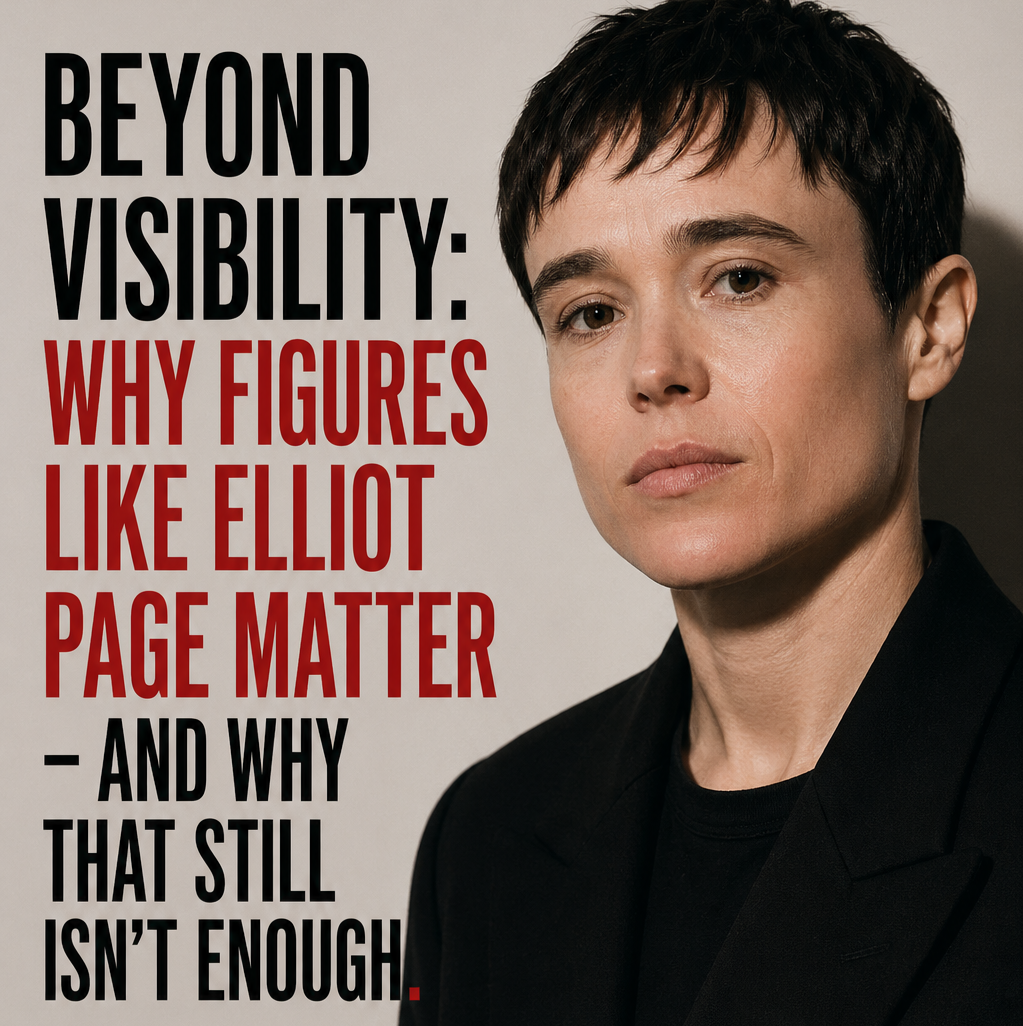
response was immediate and global. Headlines shifted. Conversations expanded. Social media filled with messages of support, curiosity, and, in some cases, resistance.
It was framed as a moment.
A breakthrough.
A milestone.
A sign of progress.
And in many ways, it was.
But moments like these are often misunderstood. They are treated as endpoints — as evidence that representation has reached a level of adequacy.
They are not endpoints.
They are indicators.
The Power of Being Seen
For many transgender people, visibility has historically been limited, distorted, or entirely absent from mainstream media. When representation did exist, it was often framed through narratives of tragedy, confusion, or spectacle.
To see someone like Elliot Page — an established actor with a global platform — speak openly about identity disrupts those patterns.
It expands what is possible.
It allows audiences, particularly younger trans people, to see a version of themselves reflected not as a stereotype, but as a full, complex individual.
That matters.
Because representation does not just inform how others see you.
It informs how you see yourself.
Visibility as Intervention
When a public figure comes out, it does more than create awareness.
It intervenes in the narrative.
It challenges assumptions about who can exist in certain spaces — in Hollywood, in mainstream media, in public life. It pushes against the idea that trans identity is marginal or incompatible with success.
This is why figures like Page carry weight beyond their individual careers.
Their visibility shifts perception.
And perception shapes culture.
But Visibility Has Limits
It would be easy to stop here.
To celebrate visibility as progress.
To assume that representation at this level signals meaningful change.
But visibility is not the same as equity.
And it is not evenly distributed.
For every figure like Elliot Page who is able to exist visibly and publicly, there are countless others navigating environments that are far less accepting.
Trans people — particularly trans people of colour — continue to face:
higher rates of violence
limited access to healthcare
employment discrimination
social exclusion
These realities exist alongside moments of visibility.
They are not erased by them.
The Burden of Representation
Public figures who come out often become more than individuals.
They become symbols.
They are expected to educate, to represent, to carry conversations that extend far beyond their personal experience.
This creates a burden.
Because no single person can represent the full spectrum of a community.
And yet, in the absence of widespread representation, they are often positioned as if they do.
This is one of the limitations of visibility.
When representation is scarce, it becomes concentrated.
And when it becomes concentrated, it becomes heavy.
Whose Stories Get Told
The visibility of someone like Page also raises a deeper question:
Whose stories are considered acceptable for mainstream audiences?
Page’s career, prior to coming out, already existed within established systems. That visibility provided a platform.
But many trans individuals do not have access to those systems.
Their stories remain less visible.
Less amplified.
Less likely to be considered “marketable.”
This reflects a broader pattern in media.
Representation often expands in ways that feel safe.
It introduces difference — but within familiar frameworks.
And while that can create entry points, it can also limit the scope of what is seen.
Media as Gatekeeper
Mainstream media does not simply reflect reality.
It shapes it.
It determines which stories are told, how they are framed, and who is given the authority to speak.
When trans narratives are included, they are often filtered through these structures.
Simplified.
Contextualised for broad audiences.
Adjusted to fit existing storytelling norms.
This can create visibility.
But it can also create distortion.
Because lived experience is not always easily translated into mainstream formats.
Representation vs Transformation
There is a difference between adding representation and transforming the system.
Adding representation means including more voices.
Transforming the system means changing how those voices are heard.
Figures like Elliot Page contribute to the first.
But lasting change requires the second.
It requires:
more trans voices behind the camera
more control over narrative
more opportunities that are not contingent on assimilation
It requires shifting from inclusion to ownership.
Why It Still Matters
Despite its limitations, visibility remains important.
Because it creates openings.
It challenges silence.
It provides points of reference for conversations that might not otherwise happen.
But it should not be mistaken for resolution.
Because visibility does not guarantee safety.
It does not guarantee understanding.
And it does not guarantee systemic change.
Beyond the Moment
Moments like Page’s coming out are often framed as turning points.
And in some ways, they are.
But their significance lies not in what they represent immediately — but in what they make possible over time.
They create space.
The question is whether that space is expanded.
Or whether it remains limited to a few.
The Work That Remains
The importance of figures like Elliot Page is not in their ability to solve systemic issues.
It is in their ability to expose them.
To highlight the gaps between visibility and reality.
To show what is possible — and what is still missing.
Because progress is not measured by individual success.
It is measured by collective change.
The Question Moving Forward
If visibility has increased…
If conversations are happening…
If representation is expanding…
Then the question is no longer whether people like Page matter.
They do.
The question is:
What happens next?
And whether the systems that have begun to shift are willing to change fully — or simply adapt enough to appear like they have.
