
LONDON’S TRANSPORT SAFETY GAP: LGBT+ PEOPLE, VAWG AND THE CCTV BLIND SPOT
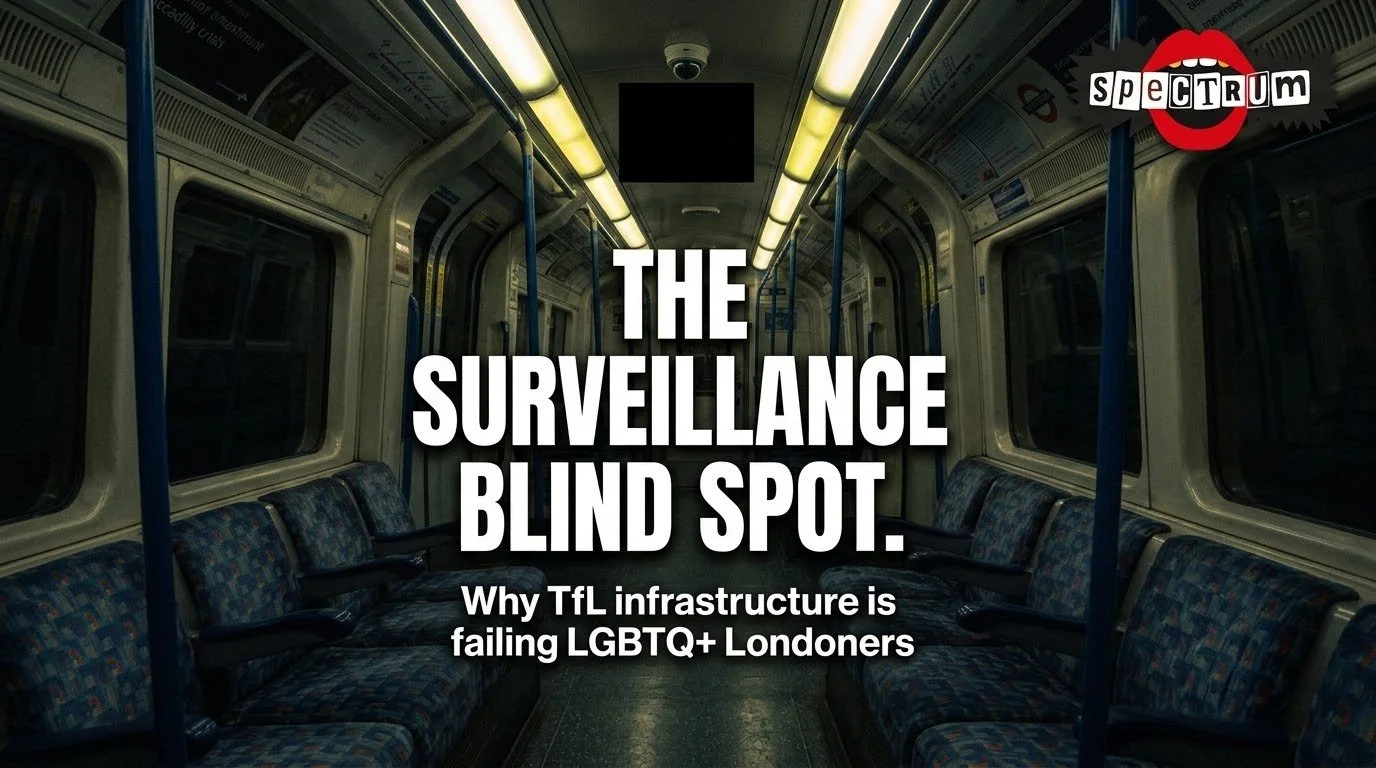
When the system knows who is at risk, knows where risk is rising, and knows where the evidence gaps are — how long are marginalised passengers expected to wait for action?
There is a question that should be uncomfortable for every organisation responsible for keeping London moving:
What happens when someone is assaulted on a train that does not have onboard CCTV?
Not what happens in the press release.
Not what happens after the incident has already occurred.
What happens in the carriage, in the moment, when there is no camera capturing what happened?
That question sits at the heart of a much bigger problem: LGBT+ hate crime, violence against women and girls (VAWG), disability-related abuse and other forms of violence and harassment do not exist in separate policy boxes.
The categories may be separate. The person isn't.
And London's transport system needs to start responding accordingly.
THE NUMBERS SHOULD ALREADY HAVE ENDED THE ARGUMENT
The London Assembly's investigation into hate crime and VAWG on public transport has put some brutal figures into the public domain.
In 2025, 4,593 VAWG offences were recorded across TfL's network. Only around 3% resulted in a charge or summons, while around 58% identified no suspect.
There were also 1,724 recorded hate crimes. Around 2% resulted in a charge or summons, while 66% identified no suspect.
These figures do not prove that every investigation failed.
They do, however, expose a system in which the gap between an incident being reported and a perpetrator being identified remains enormous.
And that matters particularly for communities that already face barriers to reporting.
London TravelWatch research found that 66% of LGBTQ+ Londoners had experienced victimisation on public transport, while 21% had experienced hate crime while travelling. Of those experiencing hate crime, 84% did not report it.
Think about that.
The official statistics are already significant.
And then there is everything that never enters the system.
THE PEOPLE MOST LIKELY TO BE MISSED ARE ALREADY TELLING US THEY ARE BEING MISSED
For an LGBT+ passenger, harassment may involve sexuality, gender identity, perceived sexuality, gender expression or a combination of these.
For a woman, it may involve sexual harassment, intimidation, stalking or violence.
For a disabled passenger, it may involve abuse, discrimination, threatening behaviour or being deliberately targeted because they are perceived as vulnerable.
For someone who sits at the intersection of several of these identities, the experience does not magically separate itself into neat categories because a database requires it to.
That is the problem.
TfL itself acknowledged in June 2026 that it does not routinely receive case-level police data covering protected characteristics including gender identity, sexual orientation, disability, ethnicity and age. TfL said it receives police-applied hate-crime flags and works with policing, specialist organisations and community groups to build a broader understanding.
That is precisely the point.
If the system cannot consistently see the person behind the incident, how can it reliably see intersectional risk?
AND THEN THERE IS THE CCTV BLIND SPOT
This is where the conversation becomes particularly uncomfortable.
In 2023, City Hall confirmed that Bakerloo, Central and Piccadilly line trains did not have onboard CCTV because of the age of their fleets.
Central line trains were being upgraded. New Piccadilly trains were being introduced with CCTV.
But the Bakerloo line required additional Government capital investment to replace its 51-year-old trains, including installing CCTV.
This is not a theoretical infrastructure problem.
It is an evidential problem.
Because there is a fundamental difference between:
“CCTV exists somewhere on the network.”
and
“There is a usable image of what happened inside the carriage.”
Those are not the same thing.
Station CCTV may show someone entering.
It may show someone leaving.
It may show a person on a platform.
But if the incident happens inside a moving carriage, the carriage can become the evidential blind spot.
And once the moment has passed, no amount of reassuring language can recreate the footage.
WE MUST STOP PRETENDING EVIDENCE IS AN AFTERTHOUGHT
To be clear: it would be irresponsible to claim that a particular LGBT+ case was lost solely because there was no onboard CCTV unless the investigation record actually establishes that.
But that does not mean the evidence gap should be minimised.
City Hall has previously acknowledged specific technical and evidential challenges around CCTV on legacy trains, including concerns about whether lighting conditions on older Central line trains would produce images suitable for evidential purposes.
Meanwhile, real incidents continue to demonstrate the importance of evidence and witnesses.
In February 2026, BTP appealed for information following an incident on a Piccadilly line service between Acton Town and Osterley in which a man allegedly made homophobic and racist remarks towards a young woman. Another passenger intervened and a fight followed. BTP subsequently released an image seeking to identify the man.
That case also demonstrates something else:
passengers are routinely being placed in the position of becoming the evidence.
A passenger sees something.
A passenger intervenes.
A passenger remembers what happened.
A passenger becomes a witness.
But passengers should not have to become an informal surveillance system simply because the infrastructure has gaps.
THIS IS NOT AN LGBT+ ISSUE IN ISOLATION
This is where the conversation with VAWG becomes unavoidable.
The Government has described VAWG as a national emergency and committed to halving it within a decade. Its strategy places prevention and early intervention alongside better policing, support and accountability.
That creates a very simple question for public transport:
What does prevention actually look like before someone becomes a victim?
Because waiting for the incident is not prevention.
Waiting for the report is not prevention.
Waiting for a victim to navigate multiple agencies is not prevention.
And discovering after the event that the evidence is incomplete is certainly not prevention.
The London Assembly has already called for a dedicated rapid-response taskforce involving TfL, the Met and BTP, alongside better London-wide data and lived-experience evidence.
The direction is clear.
The question is whether implementation will be equally clear.
TF L CANNOT JUST COUNT THE INCIDENTS
TfL is responsible for operating a transport system used by millions of people.
That responsibility is bigger than putting out another campaign telling passengers how to report something.
The system needs to ask:
Where does risk rise?
When does it rise?
Who is being targeted?
Which routes and services repeatedly generate concern?
What happens late at night?
What happens around major sporting events, festivals and nightlife peaks?
Where are the CCTV gaps?
Where are reporting rates collapsing?
Where are repeat offenders or repeat locations appearing?
And most importantly:
What are we doing before the incident happens?
A passenger should not have to survive the incident first before the system decides that their safety matters.
AND WHERE DOES SADIQ KHAN FIT INTO THIS?
This is not about personalising every failure around one individual.
It is about political accountability.
The Mayor has responsibility for the strategic direction of London's transport and policing landscape, while TfL, BTP and the Met have distinct operational responsibilities.
The Mayor's own administration has acknowledged both the scale of the problem and the need for a stronger whole-system response. City Hall's investigation has explicitly examined the roles of TfL, BTP and the Met, alongside barriers to reporting and the experiences of people with protected characteristics.
So the question for City Hall is straightforward:
Where is the measurable plan?
Not another statement.
Not another awareness week.
Not another poster.
A plan.
A timetable for closing CCTV gaps.
A published framework for intersectional transport safety.
Better data.
Faster response.
Evidence preservation.
Community intelligence.
Clear accountability.
And measurable outcomes.
PARLIAMENT NEEDS TO STOP TREATING THESE ISSUES AS SEPARATE
This is bigger than London.
Parliament has already been presented with a national VAWG strategy built around prevention, early intervention, enforcement and cross-government action.
But LGBT+ people travelling through public spaces do not suddenly stop being LGBT+ because the incident occurs on public transport.
Women do not stop being women when they board a train.
Disabled passengers do not stop being disabled when they enter a station.
And a person experiencing multiple forms of vulnerability does not experience each one independently.
The policy categories may be separate. The person isn't.
That means Parliament needs to look seriously at how an intersectional framework could operate across transport safety, VAWG, hate crime, disability and community safety.
Not as competing priorities.
As connected risks.
THE QUESTION IS NO LONGER WHETHER WE KNOW THERE IS A PROBLEM
We do.
The evidence is already there.
The London Assembly has documented the scale of VAWG and hate crime.
London TravelWatch has documented the experiences of LGBT+ passengers.
TfL has acknowledged gaps in protected-characteristic data.
City Hall has acknowledged legacy CCTV gaps.
BTP continues to investigate serious incidents across the network.
And Government has explicitly declared VAWG a national emergency.
So what exactly are we waiting for?
Another statistic?
Another victim?
Another investigation where witnesses have to reconstruct what happened?
Another passenger who decides that reporting is pointless?
Another community that learns to change its behaviour, hide its identity or avoid travelling altogether?
Because that is not safety.
That is adaptation to danger.
WHAT NEEDS TO CHANGE
Spectrum Community Projects is calling for a much more direct approach.
1. Close the CCTV blind spots
TfL should publish a clear timetable for remaining onboard CCTV gaps, including the Bakerloo line, alongside interim measures where replacement cannot happen immediately.
2. Build an intersectional transport-safety framework
LGBT+ safety, VAWG, disability-related abuse, hate crime and other forms of targeted violence should be analysed together where the risks overlap.
3. Move from reaction to prevention
Use intelligence to identify Safety Windows — periods, locations and circumstances where risk increases — and deploy targeted preventative activity before incidents occur.
4. Make reporting safer and easier
Reporting should be an option available to victims, not the price they have to pay before the system takes their safety seriously.
5. Preserve evidence immediately
Where an incident is reported, there should be rapid consideration of CCTV, witness evidence, staff observations and other available intelligence before evidence disappears.
6. Recognise trusted community organisations
Community organisations should not be treated as an afterthought. They hold intelligence about incidents that formal systems never see.
7. Make accountability measurable
TfL, City Hall, BTP, the Met and Government should be able to answer publicly: What changed? What improved? What remains unresolved?
THE PASSENGER BOUGHT A TICKET. THEY DIDN'T SIGN UP TO BE TRANSPORT POLICE.
We should not expect a young LGBT+ passenger to calculate whether their identity is sufficiently visible to attract attention.
We should not expect a woman to assess whether the carriage feels safe enough to travel alone.
We should not expect a disabled passenger to decide whether reporting abuse will be worth the effort.
And we should not expect witnesses to become investigators because the system failed to capture what happened.
Safety should be something the system produces — not something passengers negotiate.
The answer cannot simply be more reaction.
It has to be prevention.
See the risk.
Predict the risk.
Protect people before the incident.
Preserve the evidence when something happens.
Pursue those responsible.
And prove that the system has learned.
Because the most important question is no longer:
“What happened?”
It is:
