
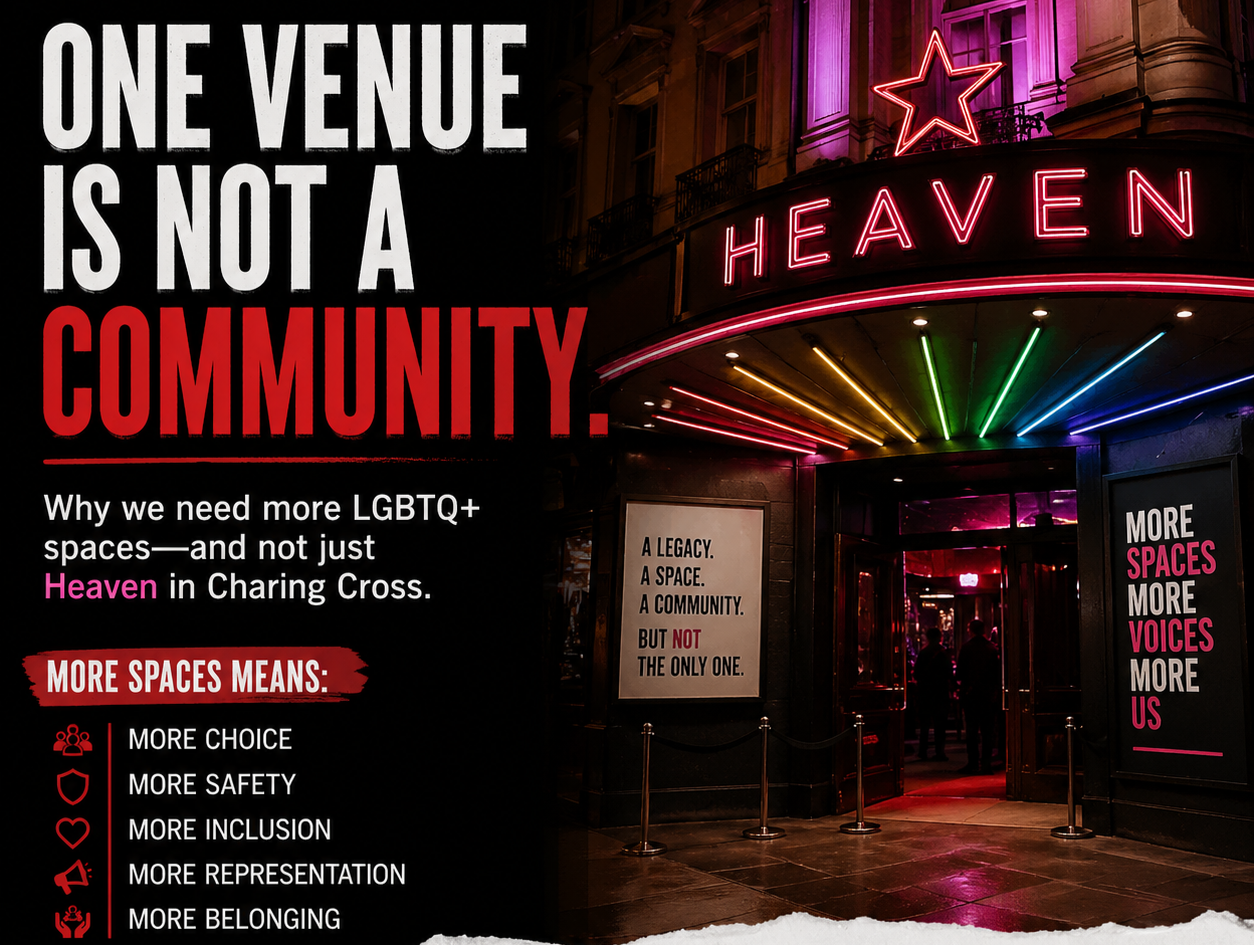
For decades, queer spaces have been more than just venues.
They have been:
places of safety
sites of resistance
centres of culture
foundations of community
In cities like London, venues such as Heaven in Charing Cross have become iconic. They hold history. They hold memory. They hold significance.
But they cannot hold everything.
And they were never meant to.
The Illusion of “Enough”
When a city points to one or two well-known LGBTQ+ venues as proof of inclusion, it creates an illusion.
An illusion that access exists.
That community is catered for.
That visibility equals availability.
But a single space — no matter how large or historic — cannot meet the needs of an entire community.
Because LGBTQ+ people are not a monolith.
One Community, Many Experiences
The LGBTQ+ community is made up of:
different identities
different cultures
different age groups
different needs
What feels safe, affirming, or accessible for one person may not feel the same for another.
A large club like Heaven offers:
scale
energy
nightlife
But not everyone is looking for that.
Some people need:
quieter spaces
daytime environments
sober spaces
community-led events
culturally specific environments
When options are limited, access becomes conditional.
The Pressure on Iconic Spaces
When only a few venues exist, they carry more than they should.
They become:
the default
the expectation
the centre of queer social life
This creates pressure — not just on the space, but on the people within it.
It can lead to:
overcrowding
lack of diversity in experience
exclusion of those who don’t fit the environment
A single space becomes symbolic.
But symbolism is not the same as accessibility.
Who Gets Left Out
When LGBTQ+ spaces are limited, exclusion becomes inevitable — even if unintentional.
People who may feel marginalised include:
trans and non-binary individuals
queer people of colour
disabled queer people
those who don’t drink or club
those seeking community over nightlife
If the only visible spaces are built around one type of experience, many people are left navigating environments that don’t fully accommodate them.
Commercial vs Community Spaces
Many well-known LGBTQ+ venues are commercial.
They operate as businesses — which is not inherently negative — but it shapes the experience.
Community spaces serve a different function.
They prioritise:
connection over consumption
inclusion over profitability
access over exclusivity
Both types of spaces are important.
But when community spaces are scarce, the balance shifts.
And something essential is lost.
Why More Spaces Matter
More LGBTQ+ spaces means:
More choice
More accessibility
More representation of different identities
More opportunities for connection
It allows people to find environments where they don’t have to adapt themselves to fit in.
Instead, they can belong.
Safety Is Not One-Size-Fits-All
Safety is often discussed in broad terms.
But in practice, it is deeply personal.
What feels safe depends on:
identity
experience
environment
A crowded nightclub may feel liberating for some.
For others, it may feel overwhelming, inaccessible, or unsafe.
More spaces create more pathways to safety.
The Risk of Cultural Narrowing
When LGBTQ+ culture becomes concentrated in a small number of venues, it risks becoming narrowed.
Certain expressions are amplified.
Others are overlooked.
This limits:
creativity
diversity
cultural growth
Queer culture has always been expansive.
It deserves spaces that reflect that.
Beyond Nightlife
LGBTQ+ life does not only exist at night.
It exists in:
conversations
support networks
creative spaces
community events
Expanding queer spaces means recognising that community is not limited to nightlife.
It is built in everyday moments.
What This Really Comes Down To
This is not about replacing iconic venues like Heaven.
It is about recognising their limits.
And understanding that community cannot be contained within a single space.
Because one venue is not a community.
Community is built through:
diversity
accessibility
shared and varied experiences
And that requires space.
More than one.
