
Recognition Without Redistribution: What MJ Rodriguez Reveals About Progress
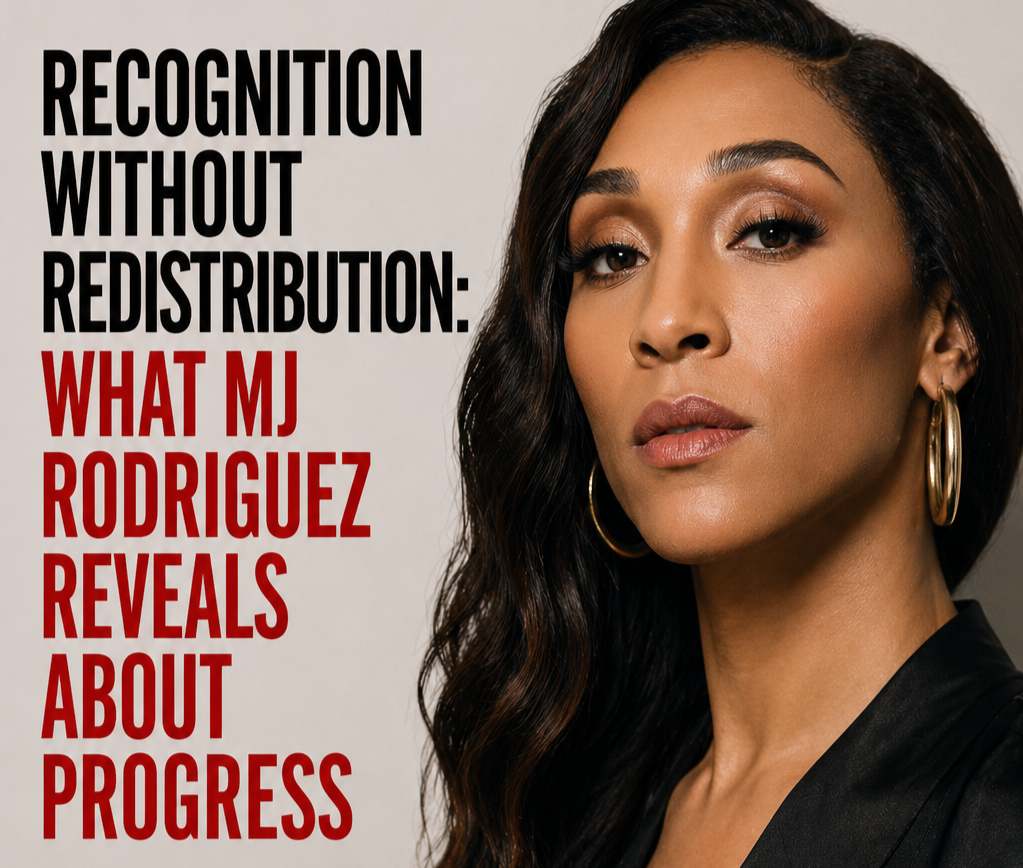
Recognition is often treated as proof of progress.
Awards. Nominations. Headlines.
They are presented as markers of change — evidence that industries are evolving, that barriers are being broken, that representation is finally being acknowledged.
When MJ Rodriguez became the first transgender woman to win a Golden Globe for Best Actress in a television drama for her role in Pose, it was framed exactly that way.
Historic.
Groundbreaking.
A moment.
And it was.
But moments do not equal transformation.
The Power of Being Recognised
Rodriguez’s win mattered.
Not just because of the award itself, but because of what it represented.
It disrupted a long-standing absence.
It acknowledged talent that had historically been overlooked. It placed a trans woman at the centre of a category that had rarely — if ever — recognised trans performers.
For many, it signalled possibility.
That visibility could translate into validation.
That recognition could follow representation.
But Recognition Is Not Redistribution
Recognition highlights success.
Redistribution changes systems.
And those are not the same thing.
While Rodriguez’s achievement was celebrated, the structures around her remained largely unchanged.
Trans actors continue to face:
limited casting opportunities
typecasting into narrow roles
exclusion from major productions
The industry acknowledged her.
But it did not fundamentally shift.
The Illusion of Progress
Moments like Rodriguez’s win can create the impression that barriers have been removed.
That the industry has “moved forward.”
But this perception can be misleading.
Because progress at the level of individuals does not necessarily reflect progress at the level of systems.
One award does not equal widespread access.
One moment does not equal sustained change.
Who Gets Recognised
Rodriguez’s role in Pose was significant.
It existed within a show that centred trans stories — particularly Black and Latina trans women — in a way that mainstream media had rarely done.
But even this raises a question.
Why are trans performers most visible in narratives specifically about trans identity?
Why is recognition often tied to roles that centre marginalisation, rather than allowing trans actors to exist across genres, characters, and stories?
The Limits of Inclusion
Inclusion can create space.
But it can also define boundaries.
It can determine:
where trans people are visible
how they are represented
what kinds of stories they are allowed to tell
Rodriguez’s success exists within these boundaries.
It expands them — but it does not eliminate them.
Representation and Reality
The gap between representation and lived reality remains significant.
While trans visibility in media has increased, the material conditions for many trans people — particularly trans women of colour — have not improved at the same rate.
This disconnect matters.
Because visibility without structural change can create:
symbolic progress
without material impact
The Weight of Firsts
Being “the first” carries significance.
But it also carries pressure.
It places individuals in positions where they are expected to represent progress — to embody change that has not yet fully occurred.
Rodriguez’s win was historic.
But it should not have been exceptional.
And until it is no longer exceptional, the system has not fully changed.
What Real Progress Looks Like
Real progress is not defined by singular achievements.
It is defined by patterns.
By consistency.
By access that is not limited to a few.
It looks like:
multiple trans actors across mainstream roles
sustained opportunities beyond breakthrough moments
recognition that is not tied to rarity
The Question That Remains
MJ Rodriguez’s success is undeniable.
But its significance lies not just in what it represents — but in what it reveals.
Because recognition can highlight progress.
But it can also expose its limits.
And that leaves us with a question:
If recognition is happening — why hasn’t redistribution followed?
