
Queerness Is Not an Aesthetic.
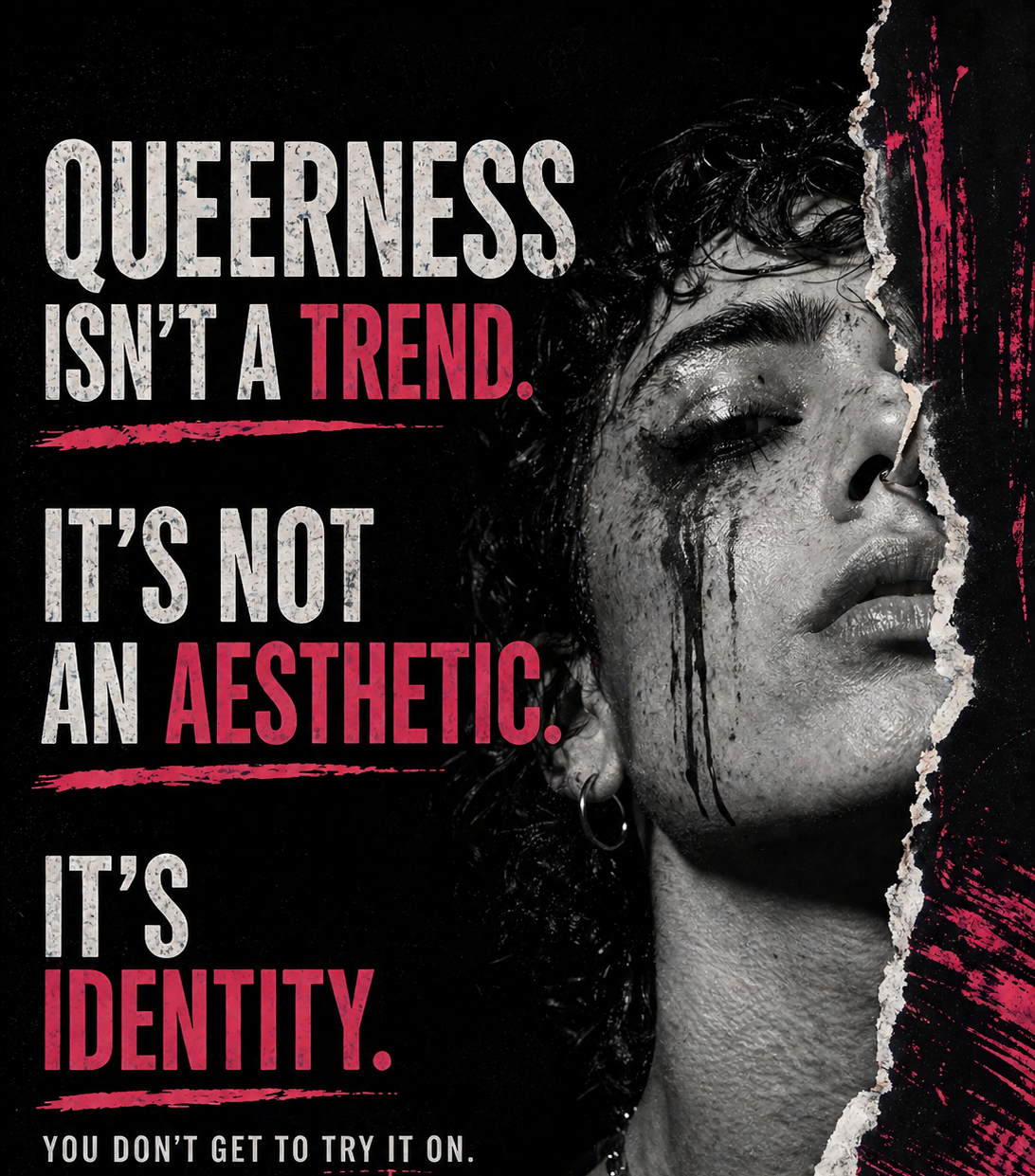
In digital culture, everything becomes visual.
Identity is curated. Styled. Presented in ways that can be quickly understood and easily shared. Platforms reward clarity — things that can be recognised instantly, categorised instantly, consumed instantly.
Within that system, queerness has increasingly been treated as aesthetic.
It appears as a set of visual cues:
fashion choices
colour palettes
body language
curated online personas
These cues are interpreted as identity.
But identity is not visual shorthand.
The Rise of Performative Identity
Social media has blurred the line between expression and performance.
For queer people, visibility can be empowering. It can create connection. It can allow identity to exist publicly in ways that were not always possible.
But visibility within digital spaces is also shaped by algorithmic logic.
What is seen is what is repeated.
And what is repeated becomes standard.
This creates pressure to present identity in ways that are recognisable. In ways that align with what audiences expect queerness to look like.
Over time, this shifts identity from something lived to something performed.
When Aesthetic Replaces Experience
Treating queerness as aesthetic removes it from context.
It disconnects identity from:
lived experience
community history
political struggle
It reduces something complex into something visual.
Something that can be adopted, imitated, and discarded.
This is where the problem begins.
Because aesthetic can be chosen.
Identity cannot.
The Difference Between Expression and Consumption
There is a difference between expressing identity and consuming it.
Expression comes from within. It reflects personal experience, history, and self-understanding.
Consumption operates externally. It engages with surface-level elements without necessarily understanding their origin or meaning.
When queerness becomes aesthetic, it becomes easier to consume.
And when it is consumed, it can be separated from the realities that define it.
Why This Matters
Queerness did not emerge as aesthetic.
It emerged as identity within systems that did not accept it.
It is tied to:
marginalisation
resistance
community formation
survival
Reducing it to trend removes that context.
And without context, it becomes easier to dismiss the experiences that come with it.
The Problem With “Trying It On”
Framing queerness as something that can be experimented with visually creates a dangerous narrative.
It suggests that identity is flexible in the same way style is.
That it can be adopted temporarily without consequence.
But for those who live it, queerness is not optional.
It shapes how people move through the world. How they are perceived. How they are treated.
It carries risk.
And that risk does not disappear when the aesthetic fades.
Reclaiming Identity
The response is not to limit expression.
It is to reclaim meaning.
To separate identity from expectation.
To recognise that queerness does not need to be legible to be valid.
It does not need to look a certain way.
It does not need to be performed.
Beyond the Surface
The expectation that identity should be visible comes from a desire to categorise.
To make people readable.
To reduce complexity into something manageable.
But queerness resists that.
It exists beyond visual definition.
The Reality
Queerness is not aesthetic.
It is not a trend.
It is not something that can be simplified into a look or a vibe.
It is identity.
And identity cannot be reduced without being distorted.
