
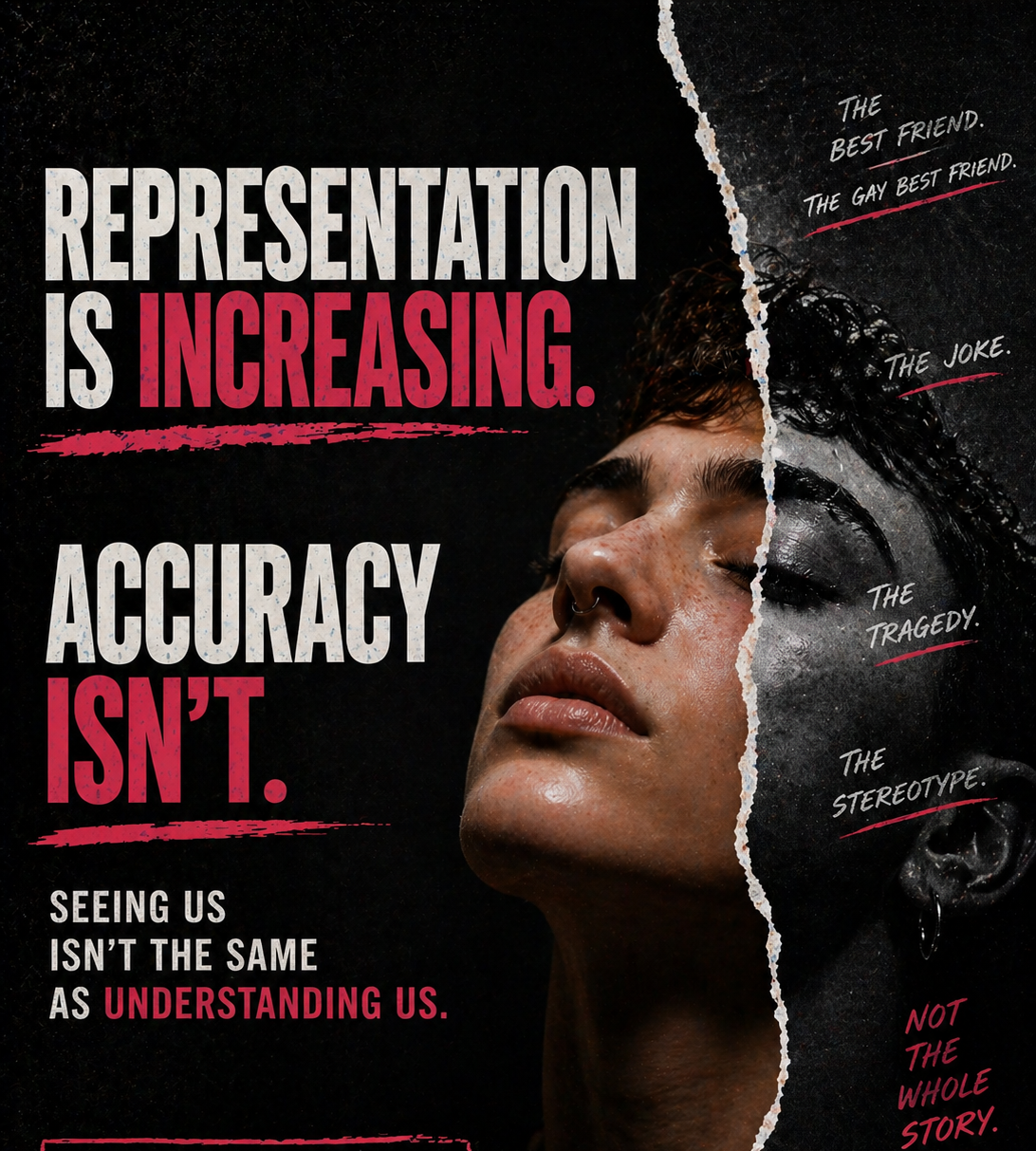
Queer representation has expanded dramatically.
Across television, film, streaming platforms, and digital media, LGBTQIA+ characters are more visible than they have ever been. Stories that were once considered niche are now positioned as mainstream. Queer identities are no longer confined to the margins of narrative — they are increasingly placed at the center.
On the surface, this appears to be progress.
And in some ways, it is.
But visibility alone does not guarantee accuracy.
And accuracy is where the gap remains.
The Illusion of Progress
More representation creates the impression of inclusion.
It signals that space has been made. That voices are being heard. That stories are being told.
But representation can exist without depth.
Without complexity.
Without authenticity.
Characters can be present without being fully realised.
And when that happens, representation becomes surface-level.
It becomes something that looks like progress — without fully embodying it.
The Persistence of Archetypes
Despite the increase in queer visibility, many narratives remain constrained by familiar patterns.
Characters are often shaped by recognisable archetypes:
the tragic figure
the comic relief
the hyper-sexualised persona
the emotionally unavailable archetype
These portrayals are not always intentionally harmful.
But they are limiting.
Because they reduce identity to a set of traits that can be easily understood by mainstream audiences — rather than allowing characters to exist as fully developed individuals.
Narratives Built for Comfort
Mainstream media is designed to be accessible.
It prioritises clarity. Simplicity. Emotional legibility.
This often means shaping queer stories in ways that feel familiar to non-queer audiences. Complexity is reduced. Conflict is framed in ways that can be easily resolved. Identity is simplified to fit within established storytelling structures.
This creates narratives that are easier to consume.
But less reflective of reality.
Because queer experiences are not always neat.
They are layered.
Contradictory.
Contextual.
And when those layers are removed, something essential is lost.
Who Controls the Story
Representation is not only about who is on screen.
It is about who is behind it.
Writers, directors, producers — the people shaping the narrative — determine how stories are told. When those voices lack lived experience, representation can become interpretation rather than reflection.
This is where distortion happens.
Not necessarily through intention.
But through perspective.
Because without direct understanding, stories are often shaped by assumption.
Visibility Without Context
Many representations focus on identity without fully engaging with context.
Characters are identified as queer — but their experiences are not explored in depth. Their relationships are visible — but the dynamics that shape them are not fully examined.
This creates a version of queerness that exists in isolation.
Detached from:
history
community
systemic realities
And while this can normalise identity in some ways, it can also flatten it.
The Risk of Simplification
Simplified representation can be appealing.
It creates clarity.
It avoids discomfort.
It allows stories to reach wider audiences.
But simplification has consequences.
Because when identity is reduced to something easily digestible, it becomes easier to misunderstand.
Stereotypes persist — even when representation increases.
The Difference Between Visibility and Understanding
Visibility is external.
It is about what can be seen.
Understanding is internal.
It requires engagement. Context. Willingness to go beyond the surface.
And the two are not interchangeable.
A character can be visible without being understood.
A story can be told without being fully heard.
What Accurate Representation Requires
Accuracy is not about perfection.
It is about intention.
It requires:
diverse perspectives
lived experience
space for complexity
willingness to challenge dominant narratives
It requires moving beyond the idea that representation alone is enough.
Because it isn’t.
The Next Step
Queer media is evolving.
But evolution requires more than expansion.
It requires depth.
It requires shifting from visibility as an endpoint to understanding as a goal.
Because the purpose of representation is not simply to show that queer people exist.
It is to reflect how they live.
