
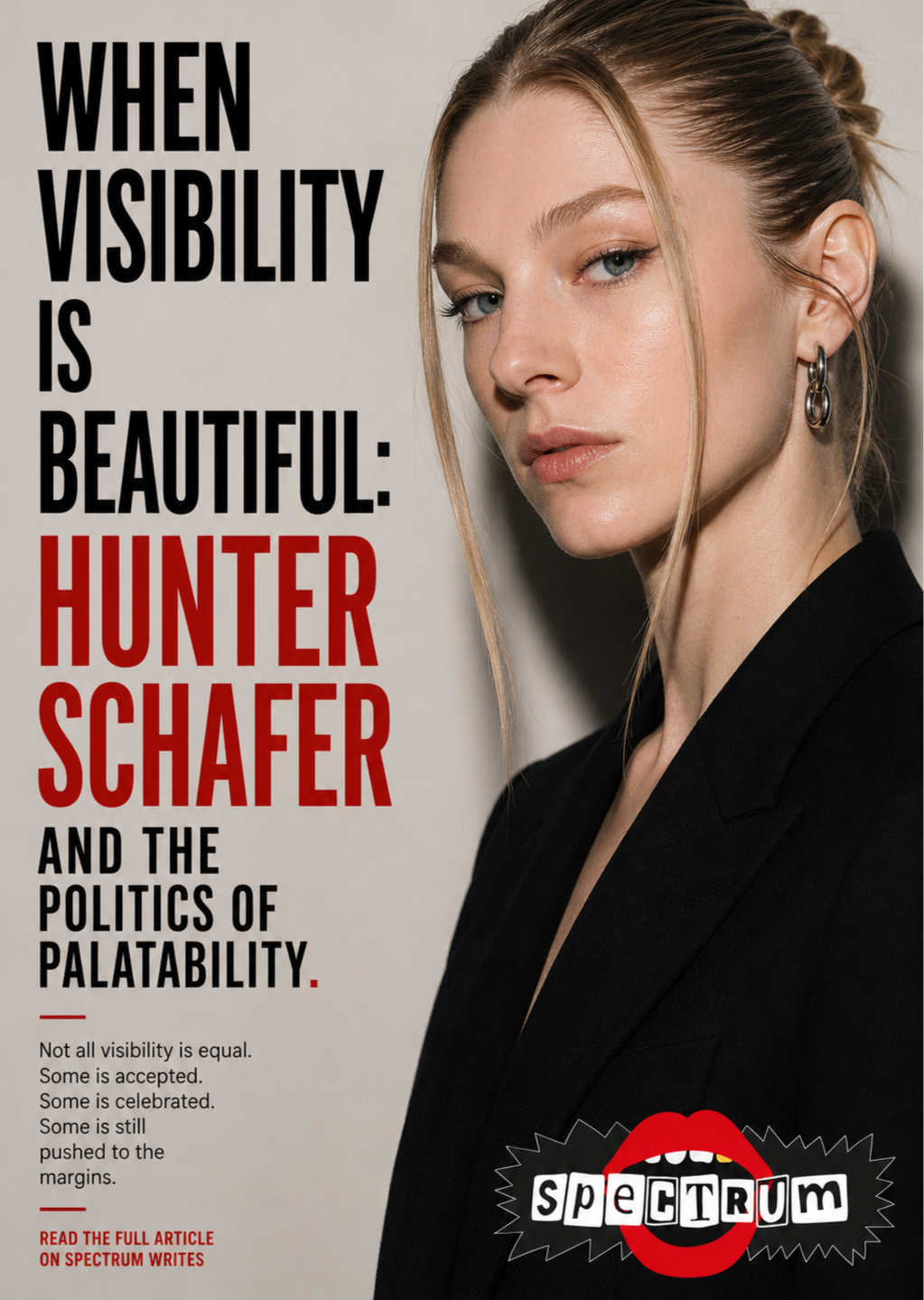
Visibility is often celebrated as progress.
When a trans person is visible in mainstream media — on screen, in campaigns, in fashion — it is taken as evidence that the cultural landscape is shifting. That acceptance is expanding. That representation is working.
And in the case of Hunter Schafer, that visibility is undeniable.
From Euphoria to high-fashion campaigns, Schafer occupies a space that was, not long ago, inaccessible to trans women in the mainstream.
She is visible.
She is celebrated.
She is, in many ways, accepted.
But acceptance is not neutral.
And visibility is not unconditional.
The Aesthetic of Acceptance
Schafer’s presence in fashion and media aligns with a very specific kind of visibility.
It is:
visually striking
culturally current
aligned with high-fashion aesthetics
Her image fits within industries that already value:
androgyny
fluidity
curated identity
This creates a form of visibility that feels seamless.
But that seamlessness raises a question.
Is this acceptance — or is it alignment?
Palatability and Permission
Mainstream acceptance often operates through palatability.
It embraces identities that can be integrated into existing systems without disrupting them too significantly.
Schafer’s visibility exists within industries that are already comfortable with pushing aesthetic boundaries — but within controlled frameworks.
This does not diminish her presence.
But it does contextualise it.
Because visibility that aligns with dominant standards is often more easily accepted than visibility that challenges them.
Who Gets to Be Seen
Schafer’s success highlights a broader pattern in representation.
Not all trans identities are given the same level of visibility.
Those who are:
conventionally attractive
aligned with industry standards
able to exist within aesthetic frameworks
are more likely to be platformed.
This creates a hierarchy of visibility.
Where some identities are elevated — and others remain marginalised.
Visibility Without Universality
Schafer’s visibility is powerful.
But it is not universal.
It does not represent the full spectrum of trans experience.
And it should not be expected to.
The issue is not that her representation exists.
It is that it exists within a system that still limits whose stories are told.
The Risk of Aesthetic Representation
When trans visibility is tied closely to aesthetics, it can become detached from lived reality.
It becomes something that is:
admired
consumed
celebrated visually
But not always understood.
This creates a gap between:
👉 how trans identity is seen
👉 and how it is lived
Beyond the Image
Schafer’s work, particularly her writing and advocacy, pushes beyond surface-level representation.
She has spoken openly about identity, politics, and the complexities of being visible as a trans woman in public space.
This is where visibility begins to shift.
From image → to voice.
From aesthetic → to perspective.
The Real Question
Hunter Schafer’s presence in mainstream media is significant.
But it forces a question that extends beyond her:
What kind of trans visibility is being accepted — and what kind is still being excluded?
Because visibility is not the same as equality.
And until representation reflects the full complexity of trans experience — not just the parts that are easiest to accept — it will always be partial.
