
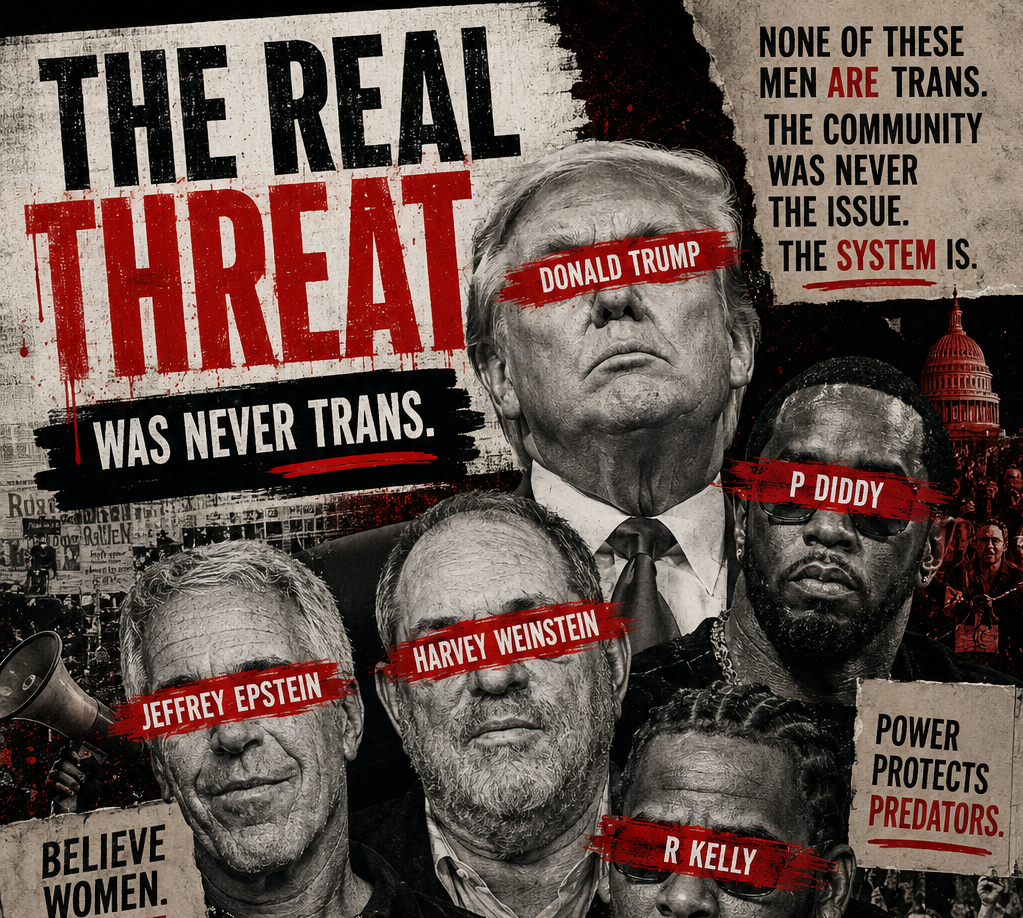
For years, public conversations around trans people — particularly trans women — have been framed around fear.
Fear of bathrooms.
Fear of changing rooms.
Fear of women’s spaces being “invaded.”
Again and again, trans identities are positioned as threats before they are ever recognised as people.
And yet, when we look at the men who have actually caused widespread harm to women — the men whose abuse has been documented, enabled, protected, and in many cases publicly known for years — a very different pattern emerges.
Because none of the names most associated with systemic sexual abuse were trans.
Not one.
The Men Society Already Trusted
The public obsession with trans people entering women’s spaces relies on a very specific narrative:
That danger comes from people crossing boundaries of gender identity.
But history tells a different story.
The overwhelming majority of violence against women has been committed not by trans women, but by cisgender men — often men already positioned within systems of power, celebrity, wealth, politics, or influence.
Men like:
Harvey Weinstein
Jeffrey Epstein
R. Kelly
Sean Combs
Donald Trump
These were not outsiders pretending to belong.
They were insiders.
Protected by institutions.
Enabled by culture.
Often celebrated while allegations already existed.
Power Was Always The Common Denominator
The public conversation around trans people often focuses on access:
Who gets into certain spaces.
Who is “allowed” near women.
But sexual violence has rarely been about access alone.
It has been about power.
The men at the centre of some of the most high-profile abuse scandals in modern culture did not need to disguise themselves to harm women.
They already had:
authority
wealth
status
influence
protection
And society gave them the benefit of the doubt repeatedly.
The Panic Was Never Applied Equally
This is what makes the conversation around trans people so revealing.
Entire political campaigns, media narratives, and online movements have been built around hypothetical dangers posed by trans women — despite a lack of evidence supporting the idea that trans-inclusive policies increase assaults in women’s spaces.
Meanwhile, allegations against powerful cisgender men have historically been:
minimised
ignored
dismissed
joked about
settled quietly
reframed as scandals rather than violence
This contradiction matters.
Because it exposes how selective moral panic can be.
The Difference Between Threat And Target
Trans people are frequently framed as threats within public discourse.
But statistically and socially, trans people — especially trans women — are far more likely to experience violence than commit it.
They are disproportionately:
harassed
assaulted
excluded
targeted politically and socially
Yet the cultural narrative often reverses this reality.
It positions one of the most vulnerable groups in society as inherently suspicious, while repeatedly failing to confront the structures that protect actual abusers.
Fear Is Easier Than Accountability
There is a reason moral panic so often focuses on trans people rather than institutional misogyny.
Because confronting systems is harder than identifying scapegoats.
It is easier to:
police identities
debate bathrooms
weaponise visibility
than it is to confront:
male entitlement
rape culture
institutional protection
celebrity power
political complicity
One conversation demands accountability.
The other demands fear.
And fear is politically useful.
The “Opportunist” Argument
Some people argue:
“What if someone pretends to be trans to gain access to women’s spaces?”
But this argument misunderstands something fundamental.
Men willing to commit assault have never needed permission from trans communities to do so.
They have done it:
as husbands
bosses
politicians
celebrities
teachers
producers
executives
freely and repeatedly for generations.
The existence of opportunistic individuals does not justify treating an entire marginalised group as inherently dangerous.
Because by that logic, every system would collapse under collective suspicion.
Who Gets Treated As A Public Danger
The disparity in scrutiny is impossible to ignore.
Trans people are expected to constantly justify:
their identity
their existence
their right to occupy public space
Meanwhile, many powerful men accused of abuse continue to receive:
platforms
support
political defence
fan loyalty
media rehabilitation
The imbalance reveals more about society’s discomfort with gender nonconformity than it does about safety.
What The Evidence Actually Shows
Study after study has failed to show evidence that trans-inclusive policies lead to increased assaults in public bathrooms or changing spaces.
But despite this, the narrative persists.
Why?
Because these conversations are rarely driven by evidence alone.
They are driven by:
cultural anxiety
political strategy
discomfort around gender itself
And fear spreads faster than nuance.
The Real Issue Was Never Trans People
The issue was never trans people.
The issue was always:
violence
misogyny
abuse of power
institutional protection of men
But addressing those things requires systemic change.
And systemic change is uncomfortable.
So instead, public attention is redirected toward people with less power, less protection, and less social legitimacy.
What Happens When Fear Becomes Policy
When moral panic becomes law, real people suffer.
Trans people lose:
healthcare access
legal recognition
public safety
community support
freedom of movement
All while the systems that enabled actual abusers remain largely intact.
That contradiction should concern everyone.
Because rights built around fear rarely stop with one group.
The Question We Should Actually Be Asking
If society is serious about protecting women, then the question is not:
“Which marginalised identities should we fear?”
It is:
Why have systems repeatedly protected powerful men despite overwhelming evidence of harm?
Because that is where the pattern exists.
Not in trans existence.
But in institutional complicity.
Beyond Scapegoats
Fear-based politics relies on creating visible enemies.
But the most dangerous systems are often the ones already embedded within culture:
celebrity worship
unchecked male power
institutional silence
social protection for influential men
Those systems existed long before trans visibility became politicised.
And they continue regardless of it.
The Reality That Keeps Being Ignored
The reality is uncomfortable because it disrupts the narrative.
The men most associated with widespread abuse were not pretending to be women.
They were men society already trusted.
And until that truth is confronted honestly, public conversations about “protecting women” will continue to target the wrong people.
