
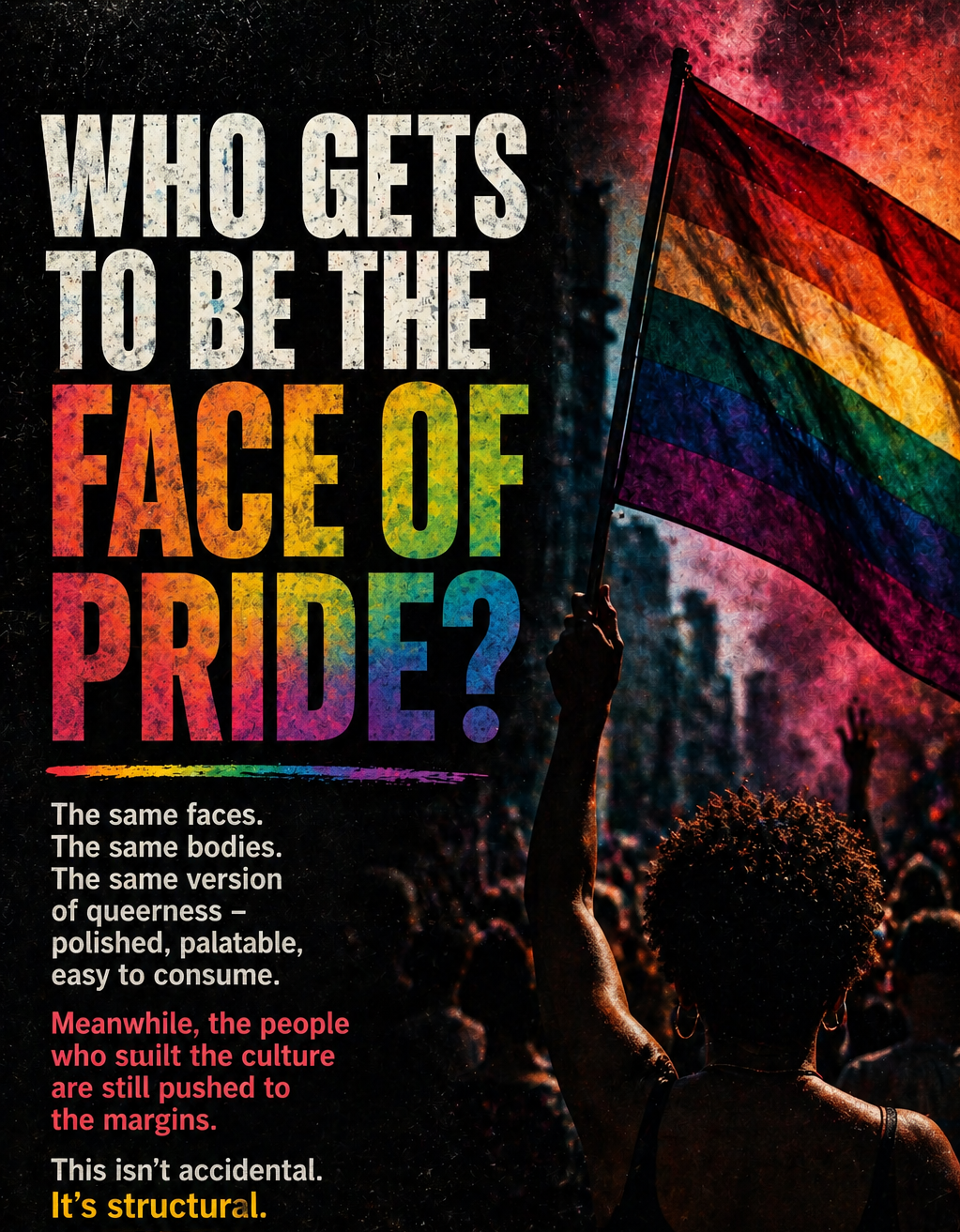
Pride has never been more visible.
It exists everywhere now — across billboards, social media, corporate campaigns, and global events that attract millions. It is celebrated as a symbol of progress, of acceptance, of a society that has, at least on the surface, moved forward.
But visibility is not neutral.
It is curated.
And when something is curated, it raises a question that Pride rarely stops to ask:
Who is being chosen to represent it?
Visibility Is Not Distributed Equally
At a glance, Pride appears diverse. Flags of every identity. People of different backgrounds. A collective celebration of queerness in all its forms.
But look closer.
The same faces appear again and again.
White. Cisgender. Conventionally attractive. Able-bodied. Gender-conforming enough to be legible, but queer enough to be marketable.
This is not coincidence.
It is selection.
The mainstream does not amplify identities randomly — it amplifies what it can easily understand, easily sell, and easily integrate into existing systems without disruption.
And disruption is exactly what Pride was built on.
From Protest to Palatability
Pride did not begin as celebration.
It began as resistance.
It was led by those who had the least protection and the most to lose — Black and Brown queer people, trans women, sex workers, those living on the margins of society. Pride was not about visibility for its own sake. It was about survival.
It was about refusing to be erased.
But as Pride moved into the mainstream, its tone shifted.
Resistance became softened.
Anger became rebranded.
Urgency became aesthetic.
The result is a version of Pride that is easier to consume — but harder to recognise as the movement it once was.
The Politics of Being “Palatable”
Palatability is not a neutral concept.
It determines who gets access to visibility and who remains peripheral.
To be palatable often means:
not being “too political”
not being “too confrontational”
not challenging dominant norms too directly
It means fitting within a version of queerness that does not disrupt comfort.
This is why certain identities are consistently centered.
Because they can be framed as relatable.
Non-threatening.
Familiar enough to bridge the gap between queer and mainstream audiences.
But familiarity comes at a cost.
Who Gets Left Out
For every identity that is amplified, there are others that are not.
Black and Brown queer communities continue to shape culture while being underrepresented in the spaces that profit from it.
Trans and non-binary individuals remain disproportionately excluded, misrepresented, or treated as secondary to the broader narrative of Pride.
Disabled queer people are often absent entirely from mainstream representation.
Working-class queer voices are rarely centered in conversations that are increasingly shaped by corporate and media interests.
This is not a failure of visibility.
It is a failure of distribution.
Representation vs Recognition
There is a difference between being seen and being recognised.
Representation can exist without depth. Without context. Without understanding.
Recognition requires more.
It requires:
accurate storytelling
acknowledgment of history
space for complexity
When Pride centers only certain identities, it does not reflect the full spectrum of queerness. It reflects a curated version of it.
And that version becomes the standard.
The Illusion of Inclusivity
Modern Pride often operates on the assumption that visibility equals inclusion.
But inclusion is not about presence alone.
It is about power.
Who gets to lead?
Who gets to speak?
Who gets to shape the narrative?
If those answers remain the same — if they continue to favour the most socially accepted identities — then Pride is not as inclusive as it appears.
It is simply more visible.
Reclaiming the Narrative
The question is not whether Pride should be visible.
It is how that visibility is used.
Because Pride has the potential to be more than a celebration. It can be a platform for redistribution — of attention, of resources, of narrative control.
But that requires intention.
It requires moving away from a model that prioritises what is easy to market, and toward one that reflects what is real.
That means:
centering marginalised voices
acknowledging the origins of queer culture
creating space for identities that challenge dominant narratives
Beyond the Surface
Pride is often described as a reflection of progress.
But reflection is selective.
It shows what is placed in front of it.
And right now, what is placed in front of Pride is not the full picture.
The full picture is more complex. More uncomfortable. More honest.
And until that complexity is fully represented, Pride will remain incomplete.
The Question Still Stands
So the question is not rhetorical.
It is necessary.
Who gets to be the face of Pride?
And more importantly:
Who doesn’t — and why?
