
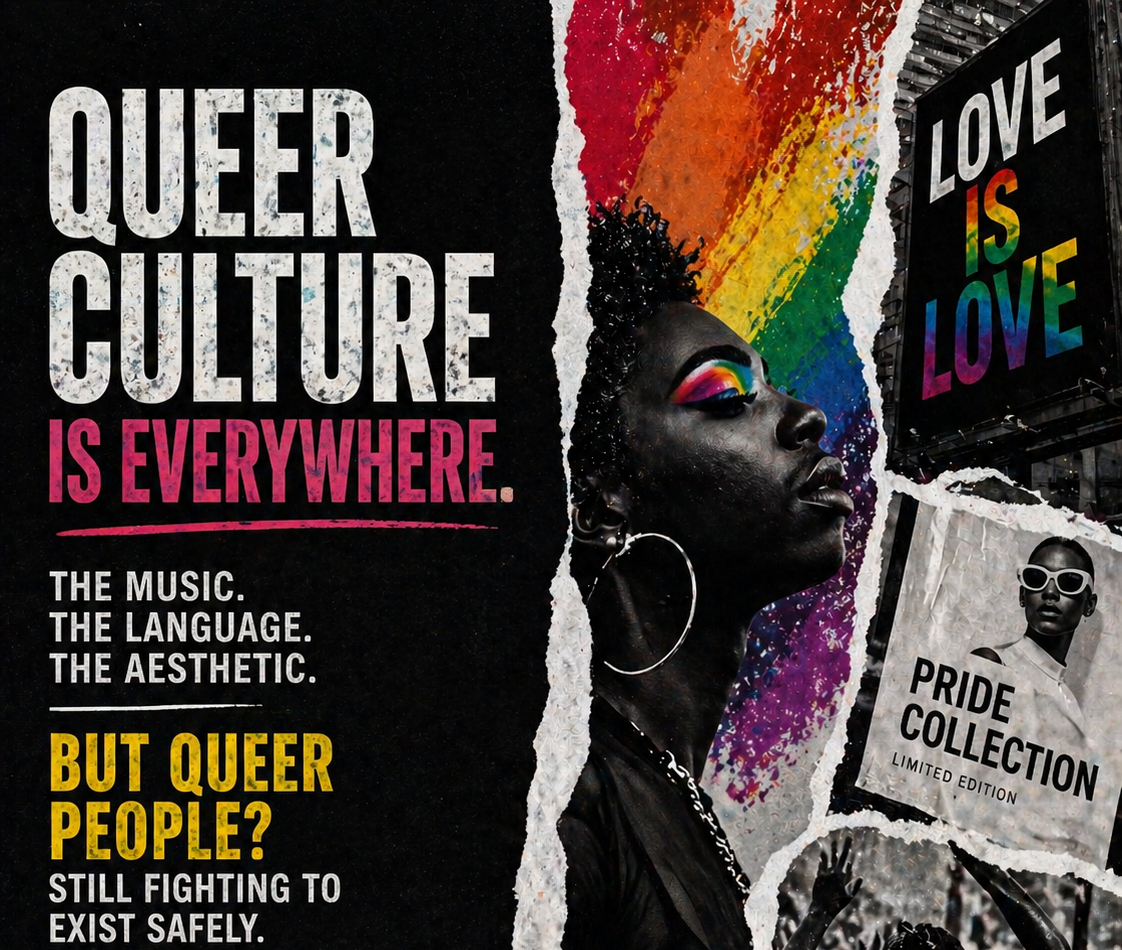
Queer culture has never been invisible.
Even when queer people were pushed to the margins, the culture they created found ways to move. It travelled through music, through fashion, through language, through underground spaces that operated outside of mainstream recognition.
It shaped the world quietly at first.
Now, it shapes it loudly.
Queer aesthetics dominate social media. Ballroom slang appears in everyday conversation. Fashion trends rooted in queer communities are replicated across global brands. Sounds, styles, and expressions that once existed in specific cultural contexts now circulate freely, often detached from their origins.
On the surface, this looks like influence.
And it is.
But influence without recognition creates a different dynamic.
Because while queer culture is being embraced, queer people themselves are still navigating exclusion, discrimination, and instability.
This is the contradiction.
The Separation of Culture and People
When culture moves into the mainstream, it rarely moves intact.
It is translated.
And translation is not neutral.
Elements are selected based on what is easy to understand, easy to replicate, and easy to sell. Complexity is reduced. Context is stripped away. What remains is the surface — the aesthetic version of something that originally carried deeper meaning.
Queer culture becomes visual.
Performative.
Consumable.
But the conditions that shaped it do not travel with it.
The struggle.
The history.
The necessity behind its creation.
Those remain largely invisible.
Ballroom, Language, and Erasure
One of the clearest examples of this pattern is language.
Ballroom culture — built primarily by Black and Latinx queer and trans communities — developed its own vocabulary. Words and phrases that carried specific meanings within that space, rooted in identity, survival, and community.
Now, many of those terms exist far beyond their original context.
They are used casually, often without understanding where they come from or what they signify.
This is not just cultural exchange.
It is extraction.
Because the language is adopted, but the people who created it are not centered in the narrative that follows.
Visibility flows outward. Recognition does not always follow.
Aesthetic Without Accountability
Queer culture has always been expressive.
But expression is not the same as aesthetic.
Aesthetic can be replicated without engagement. It allows people to participate in the appearance of queerness without engaging with the realities that shape it.
This creates a form of distance.
Queerness becomes something that can be referenced, imitated, or appreciated — without requiring any deeper understanding or commitment.
And that distance allows contradiction to exist comfortably.
People can embrace queer culture while holding beliefs that do not support queer people.
They can consume the aesthetic while rejecting the identity.
Mainstream Comfort vs Queer Reality
The mainstream often absorbs culture in ways that reduce friction.
It takes what can be integrated without disruption.
But queer culture was never designed to be comfortable.
It was built in response to discomfort — to exclusion, to marginalisation, to the need for spaces that did not exist elsewhere.
It carries history.
And when that history is removed, the culture changes.
It becomes easier to engage with, but less reflective of the realities it came from.
The Cost of Being Influential
Influence is often framed as power.
But for marginalised communities, it can also create vulnerability.
Because when culture becomes widely accessible, control over its narrative often shifts.
The people who created it are no longer the only ones shaping how it is understood. Their voices become one of many — often competing with louder, more dominant platforms that reinterpret the culture for broader audiences.
This can lead to distortion.
To misrepresentation.
To a version of queer culture that exists everywhere, but feels disconnected from the people it originated from.
Visibility Without Protection
The presence of queer culture in mainstream spaces does not guarantee safety for queer people.
Visibility does not automatically translate into protection.
Queer individuals still face:
discrimination in workplaces
hostility in public spaces
legislative challenges
disproportionate mental health struggles
These realities exist alongside the widespread adoption of queer culture.
Which raises a difficult question.
If the culture is accepted, why aren’t the people fully accepted too?
The Difference Between Celebration and Consumption
There is a difference between celebrating a culture and consuming it.
Celebration involves recognition. Respect. An understanding of where something comes from and what it represents.
Consumption requires less.
It allows engagement without responsibility.
And when queer culture is consumed rather than understood, it risks being reduced to trend rather than treated as lived experience.
Reconnecting Culture to Community
The goal is not to limit the reach of queer culture.
It is to reconnect it to its context.
To ensure that as it continues to influence the mainstream, the communities behind it are not erased in the process.
This requires:
acknowledgment of origins
amplification of queer voices
awareness of how culture is being used and represented
Because culture does not exist independently.
It is created by people.
And when those people are excluded from the spaces that benefit from their contributions, something is lost.
The Reality Beneath the Surface
Queer culture is not just aesthetic.
It is not just language.
It is not just influence.
It is history.
It is survival.
It is identity.
And until the mainstream engages with it on that level — not just visually, but structurally — the gap between culture and acceptance will remain.
The Question Still Holds
If queer culture is everywhere…
why aren’t queer people fully safe everywhere too?
