
Straight-Passing: Privilege, Pressure, or Both?
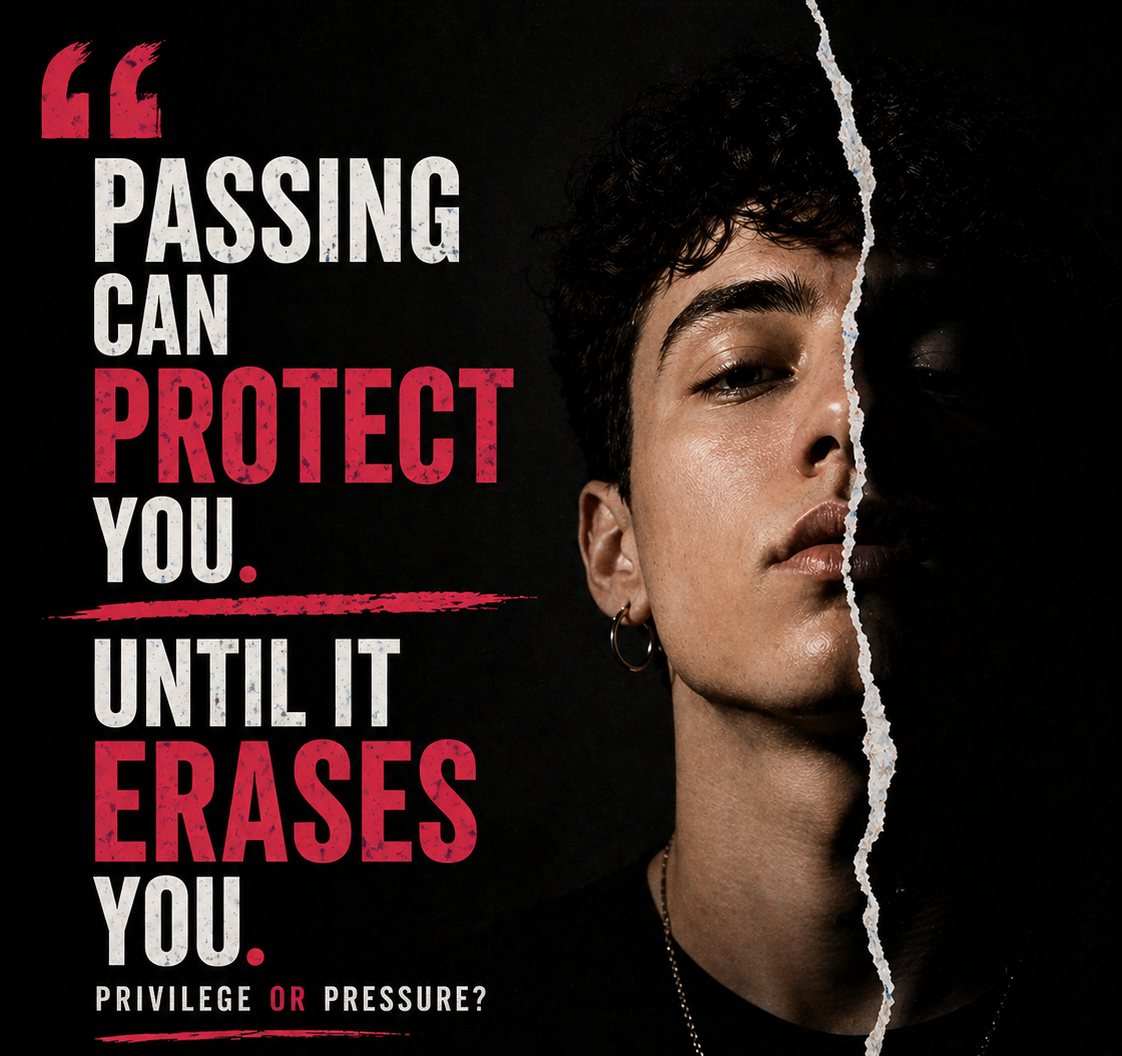
“Straight-passing” is often spoken about in simple terms.
As either advantage or disadvantage.
Protection or erasure.
Privilege or invisibility.
But the reality is more complex.
Because passing is not a fixed state.
It is situational.
And it is shaped by context.
What Passing Actually Means
Straight-passing refers to the ability to move through the world without being immediately read as queer.
This can be influenced by:
appearance
relationship presentation
behaviour
assumptions made by others
It is not always intentional.
And it is not always consistent.
A person can be read as straight in one space and queer in another. The same identity can be interpreted differently depending on who is looking — and what they expect to see.
The Safety It Can Offer
In certain environments, passing can reduce risk.
It can limit exposure to:
harassment
discrimination
unwanted attention
It can create a level of ease in situations where being visibly queer might invite scrutiny or danger.
This is where the idea of “privilege” comes from.
Because safety, even conditional safety, has value.
But that safety is not absolute.
And it often comes with conditions.
The Cost of Invisibility
Passing does not just protect.
It also obscures.
When identity is not recognised, it often has to be explained — repeatedly. Coming out becomes a constant process rather than a singular moment.
There is also the emotional impact of not being seen.
Of having relationships misinterpreted.
Of having identity questioned or dismissed.
Of existing in spaces where recognition is not automatic.
Invisibility can create distance.
Not just from others, but from community.
Conditional Acceptance
Passing often relies on ambiguity.
It allows someone to exist within dominant spaces without disruption — as long as their identity remains unspoken or unconfirmed.
This creates a form of conditional acceptance.
You are accepted as long as you are not fully known.
And that condition can be limiting.
Because authenticity requires visibility.
Tension Within Queer Spaces
The complexity of passing does not end in the outside world.
It extends into queer spaces as well.
Where visibility can be tied to legitimacy.
Where identity is sometimes measured against expectation.
Where people who “don’t look queer” can be questioned, doubted, or dismissed.
This creates a different kind of pressure.
To prove identity.
To perform queerness in ways that are legible to others.
And again, the question of safety shifts.
Privilege vs Pressure
Framing passing as either privilege or pressure oversimplifies the experience.
Because it is both.
It can offer protection while creating erasure.
It can provide ease in some situations while generating tension in others.
It can be beneficial in environments that are unsafe, and challenging in environments that are meant to be inclusive.
The Deeper Issue
The conversation around passing ultimately reflects a broader issue.
The expectation that identity should be visible.
That queerness should be recognisable.
That there is a “look” that confirms legitimacy.
But identity is not visual shorthand.
It is internal.
Relational.
Lived.
And when visibility becomes the measure of authenticity, it creates unnecessary boundaries within the community.
Moving Beyond the Binary
Rather than asking whether passing is privilege or pressure, the more useful question might be:
Why do we expect identity to be visible at all?
Why does recognition depend on appearance?
And who benefits from those expectations?
The Reality
Passing is not a solution.
It is a condition.
One that exists within systems that still struggle to fully accept queer identity.
Until those systems change, passing will continue to carry both advantage and cost.
